
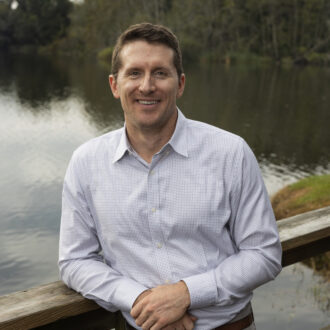
Brett Scheffers, Ph.D.
Associate Professor of Wildlife Ecology and Conservation
Institute of Food and Agricultural Sciences
Climate change, wildlife trade and biological invasions are reshaping ecosystems around the world, often in ways that are difficult to predict. Brett Scheffers’s research focuses on understanding those changes. That helps scientists and policymakers anticipate how species will respond and identify opportunities to protect biodiversity in a rapidly shifting environment.
Scheffers studies how environmental change affects where species live and how they survive. His work combines field research with large-scale modeling to understand the limits that shape species distributions, from temperature extremes to habitat conditions. The research brings together multiple disciplines to understand biodiversity under global change, assessing both vulnerability and resilience across landscapes and ecosystems.
His research spans regions of Asia, Africa and the Americas, examining how species respond to changing climates in different environments. The findings show that while many species face significant risks of decline, certain habitats and conditions can buffer those impacts and offer pathways for conservation and restoration. This work has informed species vulnerability assessments used by international organizations and resource managers.
Scheffers’s work also addresses the global wildlife trade, including its role in the spread of invasive species. In the United States, he has documented the transfer of thousands of species, many of which can establish populations outside their native ranges. That effort helps predict future risks and supports more effective management strategies.
His contributions reflect a program that helps scientists better understand the complex and biologically diverse world and the environmental challenges it faces, department chair Steve Johnson noted.
Scheffers has also taken on a leadership role in building research networks and collaborative initiatives. He co-founded an international conference focused on species movement under climate change and helped establish research networks that generate high-resolution climate data for ecological studies. He also plays a key role in developing digital tools that make biodiversity information more accessible to researchers, managers and the public.
Through research, collaboration and public engagement, Scheffers is helping define how scientists understand and respond to global environmental change.