
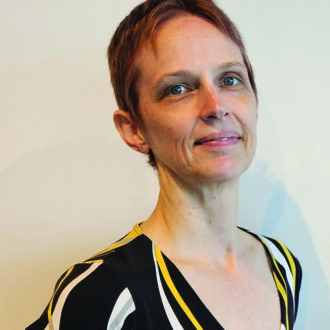
Corene Matyas, Ph.D.
Professor of Geography
College of Liberal Arts and Sciences
A pioneering expert in tropical meteorology and severe weather, Matyas focuses on the spatial analysis of rainfall associated with tropical cyclones, including hurricanes. Their interdisciplinary work leverages Geographic Information Science and “big data” from remotely sensed ground-based and space-borne radars as well as global precipitation and reanalysis databases to uncover patterns in storm precipitation, which influences risk assessment, preparedness and public safety.
Matyas’ research on tropical cyclones is critical to Florida, which receives more landfalls than any state in the country. Their primary research aims to better understand storm structure and precipitation extremes to improve indicators of tropical cyclone evolution and to measure the processes that drive precipitation in high-impact weather events.
Matyas began their academic journey with a bachelor’s degree in environmental geosciences from Clarion University in 1999, followed by a master’s in physical geography from Arizona State University in 2001 and a Ph.D. in climatology from Penn State in 2005. They joined UF in that same year as an assistant professor and have been a full professor since 2020.
Throughout their career, Matyas has earned numerous honors, including a CAREER Award for research from the National Science Foundation, UF’s College of Liberal Arts & Sciences Teacher of the Year in 2009 and 2019, the Southeastern Division AAG Excellence in Teaching Award in 2019. They were named a 2025 Association of American Geographers Fellow for contributions to research, teaching and service in geography, including community-relevant science communication.
Jane Southworth, chair of the Department of Geography, said Matyas is an outstanding member of the community who brings positive energy and a student- oriented approach to their programs.
Their current research explores how environmental conditions shape tropical cyclone rain shields. Matyas and collaborators have implemented artificial intelligence to identify six distinct rainfall patterns and four moisture regimes over the past 20 years in the Atlantic Basin, advancing our understanding of storm dynamics.
“Looking ahead, Dr. Matyas is poised to continue making groundbreaking contributions to the study of hurricane precipitation, extreme weather and geospatial climate analysis,” Southworth adds.
In addition to this meteorological work, Matyas connects science and visual art. They create sculptures inspired by natural phenomena, such as rainwater filtration systems that reflect their interest in human- weather interactions. Matyas’ work intersects science, technology, art and public policy, making critical strides in meteorology research while enriching the academic and broader communities.