
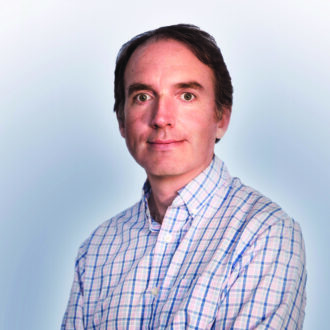
Michael Jury, Ph.D.
Professor and Associate Chair of Mathematics
College of Liberal Arts and Sciences
Michael Jury specializes in functional and complex analysis, with a particular focus on operator theory and noncommutative function theory. His publication record includes innovative work on Hardy spaces, Pick interpolation, Toeplitz algebras and noncommutative convexity. His recent projects include collaborations on Nevanlinna-Pick interpolation, convexity in noncommutative settings and factorization in free Hardy and Fock spaces.
In addition to his research contributions, Jury plays a vital role in department leadership and graduate education. He leads the Graduate Committee, chairs key faculty search committees and serves as graduate coordinator and associate chair, ensuring academic quality and supporting student development.
Jury teaches advanced graduate courses such as real analysis and functional analysis, routinely offering in-depth instruction on measure theory, Banach and Hilbert spaces, the Radon-Nikodym theorem, Fourier analysis and operator spectral theory.
Over the past five years, Jury has published 18 articles in top-tier mathematical journals, including the Transactions of the American Mathematical Society, Journal of the London Mathematical Society, Advances in Mathematics, Indiana University Mathematics Journal and the Journal of Functional Analysis. In recognition of his scholarly excellence, he was named a UF Term Professor in 2019. He also serves as an associate editor for two leading journals, the Canadian Journal of Mathematics and the Canadian Mathematical Bulletin.
“Dr. Jury is an exceptional researcher in the field of mathematical analysis and operator theory, whose contributions have placed him among the leading scholars in his discipline,” said Libin Rong, chair of the Department of Mathematics. “His work is recognized both nationally and internationally for its depth, originality and impact.”
His research efforts have been supported by three National Science Foundation grants totaling over $400,000 in the last five years. He has been invited to deliver talks at prestigious conferences and workshops, including the Operator Theory Conference in Lisbon.